
PROFESSIONAL BLOG
NOVEMBER 17, 2024 • 7 MIN READING
How we help you from idea to mass production
Have you ever had a great product idea that you would like to bring to life, but were unsure how to proceed? At Plexx, we help you through the entire process – from concept to finished product on a large scale.
Arild S. Johnsen
CEO Plexx

Taking an idea from the brain to a finished product that can be manufactured at scale can seem like a daunting process. At Plexx, we offer a full range of services from design and prototyping to mass production of plastic products. In this article, we explore how we work with our clients to bring product ideas to life – from concept to finished product.
The Idea Phase: Defining and Shaping the Concept
Every product starts with an idea, and at Plexx we understand that this is a crucial point in the development process. Our experienced consultants and engineers work closely with you to define your product and identify the best options for manufacturing.
In this early phase, we discuss material choices, design options, and manufacturing methods. We help you assess which materials and technologies are best suited for your product, and we look at production volumes – from small series to full-scale mass production – to tailor the approach.

WE WANT A CLOSE COLLABORATION FROM DAY ONE

The design and development phase
Once the idea is defined, we create a design that can be further developed into a prototype. At Plexx, we use modern CAD software to create a detailed digital model of the product. This design gives you a visual representation and allows us to test functionality, dimensions and customization.
We perform simulation and design analysis to test strength, functionality and durability, so that weaknesses can be identified and corrected before physical prototyping. Collaboration between our designers and you as the customer is key.
Prototyping: From digital design to physical model
Once the design is in place, we create a prototype – a physical model used to test functionality and appearance. We use different techniques depending on the complexity of the product: 3D printing for rapid prototyping and CNC machining for more complex parts that require high accuracy.
3D printing allows us to create a physical model quickly and cost-effectively, while CNC machining produces the prototype in the material that will be used in the final production.

RAPID PROTOTYPING WITH 3D PRINTING
Testing and validation
After the prototype is created, we perform extensive testing to validate the product. This involves testing durability, functionality, safety, and performance under various conditions. We collect feedback from you and potential users to ensure that the product works as intended.
Testing gives us the opportunity to correct errors or weak points before mass production. We use, among other things, stress testing and simulation of usage conditions to ensure that the product meets the required standards.

Production tools and preparation
Once the product is approved after testing, we start preparing for mass production. This involves creating production tools and molds that will be used on a larger scale. We have expertise in injection molding, vacuum forming and Twin Sheet forming, and will choose the method that best suits your product.
Production tools can be a significant investment – that's why we place great emphasis on developing tools that provide high precision, durability and efficiency.
Mass production: From prototype to market
Once the production tool is ready, we move on to mass production. At Plexx, we use modern production equipment to ensure efficient production in line with the highest quality standards. We can produce everything from small components to large plastic parts.
During mass production, we focus on quality control throughout the process. Our inspectors check dimensions, surface quality and perform tests on finished products to ensure they meet expectations.
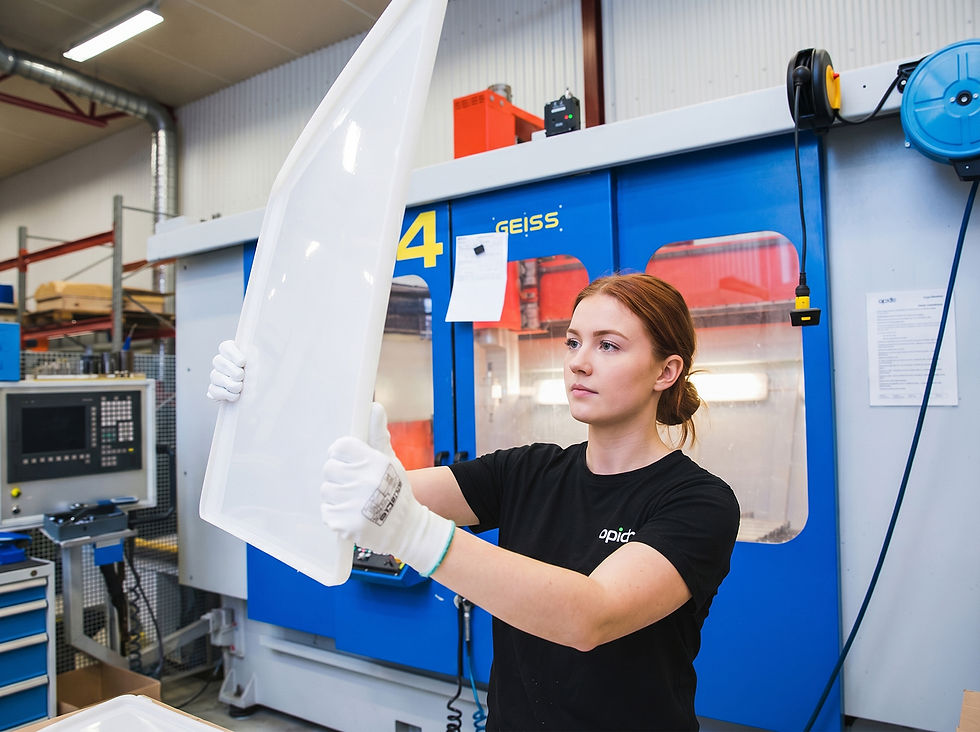
QUALITY CONTROL IN PRODUCTION
Logistics and delivery
After your products are manufactured, we help you plan delivery strategies to ensure they arrive efficiently and cost-effectively. We offer flexible logistics and distribution solutions – whether you need delivery directly to your business or distribution to multiple locations.
Aftermarket and further development
The process doesn't end when the product is delivered. We offer after-sales services and follow-up to ensure the product works as expected. We can help with adjustments, further development or new variants based on experience and feedback.
We also offer maintenance and support for production tools, ensuring smooth production for future series or increased demand. Our goal is to be a long-term partner throughout the product lifecycle.
"We offer a holistic approach that covers all stages of the development and production process, from ideation, design, and prototyping, to testing, production preparation, mass production, and delivery."
Frequently asked questions
The timeline varies depending on the complexity of the product. A simple component can be ready for production in a few weeks, while more advanced products can take several months including prototyping and tooling.
Costs depend on the product design, material selection and production method. We provide you with a detailed cost estimate early in the process so you can make informed decisions.
Absolutely! We help customers at every stage — from a simple sketch on paper to a finished CAD model and production. Our engineers take it from there.
We handle everything from single prototypes and small series to full-scale mass production with thousands of units. The production method is adapted to the volume.
We work with a wide range of thermoplastics — ABS, PC, PE, PP, PMMA, POM, PEEK and many more. We recommend the material that best suits your product based on application and requirements.
Do you need help moving forward with your idea?
We help you through the entire process – from design to finished product. Contact us to see how we can help you with your production.