

Machining
POM, PEEK and precision
CNC milled and turned parts in technical thermoplastics - from prototypes to series production. 5-axis simultaneous milling, live-tool lathes and automated pallet systems keep cycle times short and repeatability high. Send us the file and you will receive a technical assessment and price back.

5-axis simultaneous milling and live-tool turning in technical plastics
Lead times measured in days – we start from plates and bars
Finishing under one roof: bending, welding, gluing, laser engraving
TECHNOLOGY
Subtractive manufacturing in engineering thermoplastics
Machining removes material from a solid workpiece using milling cutters and turning tools until the geometry is complete. Because we start from standard plates and bars, no tooling investment is required, and design changes are handled by updating the CAM program. This provides very tight tolerances, fast lead times and full flexibility - ideal for prototypes, small series and parts where injection molding is not cost-effective. Post-processing such as bending, welding, bonding, printing and laser engraving are performed in-house, so you get a finished component ready for assembly.

CAPACITY
What we can deliver.
AXIS SETUP
3- and 5-axis CNC
TOLERANCES
Down to ± 0.02 mm
LEAD TIME
Short lead times
FILE FORMATS
STEP, IGES, DXF, PDF
POM (Delrin®)
Wear resistance and dimensional stability — gears, bearings, mechanical parts.
PEEK
Extreme performance and high temperature — subsea, medtech, chemical-resistant environments.
PA / PA6G (cast nylon)
Impact-resistant with good wear properties in large dimensions.
PTFE (Teflon®)
Lowest friction, chemically inert — seals and sliding parts.
PMMA / PC
Optical and impact-resistant parts — display, windows, cabinets.
ESD-safe qualities
Antistatic plates and rods for electronics and cleanroom applications.
AREAS OF USE
Plexx has delivered machined elements to:
Prototypes and small series
Functional parts in the right material before possible series production in injection molding.
Medical fixtures and test rigs
Precision components for medtech, laboratories and production lines where tolerances must be met.
Mechanical components
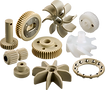
Gears, housings, bearing guides and sliding parts in POM, PA and PEEK.
WHEN TO USE MACHINING
Choose this method when…
You need finished parts quickly without the expense of a tool
Tolerances are tighter than what casting naturally provides
The volume is low – from one-offs up to a few thousand pieces
The geometry changes frequently and you want to avoid tool changes
The material – such as POM, PA, PEEK, PTFE or ESD grades and more.
BENEFITS
Why choose CNC machining?
Machining provides precision, flexibility and short lead times - without tool investment.

Ultra-tight tolerances
Perfekt for medisinske fiksturer, transportbånd-komponenter, testrigger og presisjonsdeler med strenge krav.

No tooling investment
Økonomisk fra prototype opp til noen tusen stykker – du betaler ikke for produksjonsverktøy.

Wide material selection
Plater og stenger i høytemperatur-, kjemikaliebestandige eller ESD-sikre kvaliteter.

One-stop shopping
Merking, polering, bøying, sveising, liming, trykk, lasergravering og delmontering på samme sted.

Seamless upscaling
When the volume grows, we can migrate to injection molding – same team, same design basis.
FINISHING
Finished component - not just a milled workpiece
We take the part all the way from plate or bar to fully assembled component. After machining, we offer bending, ultrasonic welding, bonding, printing and laser engraving.
Close collaboration with SP Group's designers provides rapid feedback on manufacturability (DFM), and we can qualify prototypes quickly before any scale-up to injection molding.
As the volume grows, we can move to injection molding within the same SP Group team – you keep the design basis and supplier relationship.
FAQ
Frequently asked questions about machining
Machining pays off from prototypes up to a few thousand pieces. When the volume grows beyond this, injection molding usually becomes more cost-effective because the tooling cost is spread over multiple parts.
We typically keep to ± 0.02 mm depending on material, geometry and part size. Send us the drawing and we will assess whether the requirements are manufacturable.
POM, PEEK, PA/PA6G, PTFE, PMMA, PC and ESD-safe grades and more — plus aluminum for tools and jigs. We have a wide range of sheets and rods in stock.
Yes. We offer hot/cold bending, ultrasonic welding, bonding, printing, laser engraving, polishing and sub-assembly — all in-house so you get a finished component.
We can move production to injection molding within the SP Group system. You retain the design basis and supplier relationship, and get scaled cost per part.
STEP, IGES and SolidWorks are preferred for 3D geometry. DXF and PDF work for 2D drawings and tolerance sets.
Yes. We provide quick feedback on manufacturability, material selection, and tolerances — so you avoid expensive surprises later in the project.